
Six ESG Highlights for 2026
With 2026 in full swing, many people are working to get their plans for the year moving forward. For ...
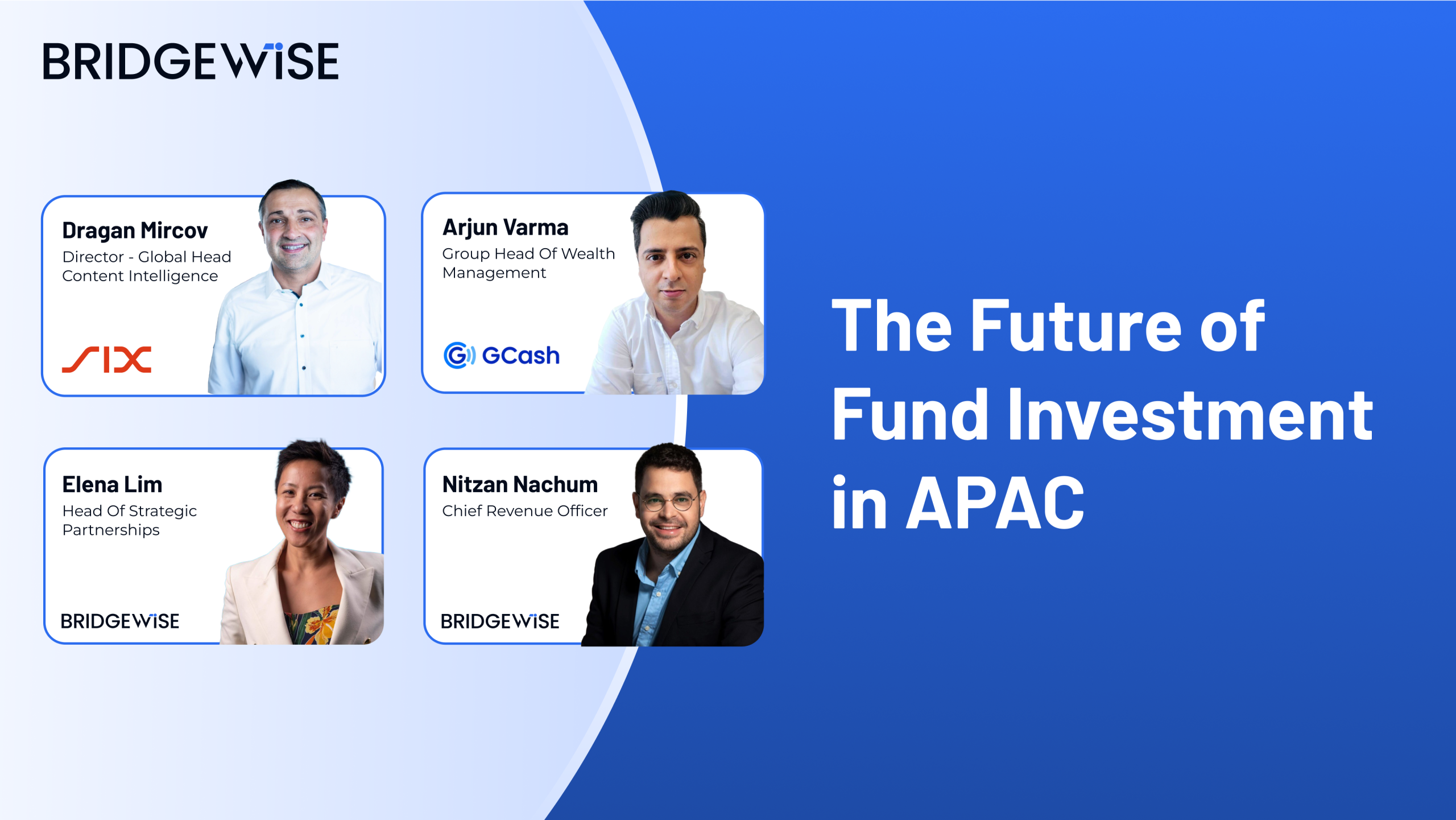
As the finance industry considers the future of investments in APAC, it does so in a climate of uncertainty related to US policy, inflation, and the global economy. Should we expect a fundamental change in strategy? To help shed light on this critical topic, moderator Elena Lim, head of strategic partnerships at BridgeWise’s Singapore office, spoke with Dragan Mircov, the global head of content intelligence at SIX Swiss Exchange; Arjun Varma, GCash vice president and general manager of wealth management; and Nitzan Nachum, CRO of BridgeWise, to hear their points of view.
We’ve laid out below the key insights on what to expect in APAC markets:
To start off the conversation, Elena asked the panel about what they think are the biggest shifts right now in how investors approach funds. Dragan explained how investment levels, and the nature of the funds themselves, have changed:
“For ETFs, we saw five years of low asset-under-management inflow, but this massively changed in the past year. This is particularly due to exchange traded instruments [ETIs], which is an ETF traded on the exchange itself. They don’t need legal registration. Also, public awareness and transparency [e.g. the composition of a fund] for ETIs is growing. Inflows are also being driven by complex instruments such as private equity and debt.”
Market volatility can be seen as an opportunity. How do the experts see AI as a tool for understanding and taking advantage of these shifts?
Nitzan answered: “First of all, AI provides access to information that lets me get into the details of any fund or stock. At BridgeWise, this takes the form of bottom-up analysis. We can analyze every underlying asset one by one. Secondly, transparency gives an answer to questions that investors can ask of their broker, such as why they are recommending a specific fund.”
Elena followed up by referencing AI. With this fast shifting of economic trajectories, do you see investors redefining their strategies through technology? According to Dragan:
“People are starting to build AI-driven investments, but restrictions in terms of regulatory requirements are always the challenge. It is a balance. You need to fulfill regulatory requirements and protect the investor, but still give them investments that fit their profile. AI gives you access to the data to address all of these issues, so investors can evaluate a wider variety of choices.”
Arjun illustrated the potential of financial AI through the example of Filipino investors.
“Filipino investors have a very high level of digital adoption and are among the most active mobile internet users globally. But they are also very conservative and prefer guaranteed products, like time deposits and insurance, over market-linked investments. Financial literacy is also a major issue.
“Digital products are an ideal access point, especially for first-time investors who are more comfortable transacting on mobile. We can educate users through an in-app financial coach in a personalized and contextual way so that they trust us. We also build trust because all of our investment products are offered in partnership with regulated institutions.”
Elena commented, “Speaking of APAC investors, BridgeWise recently went live with Rakuten Securities in Japan. 25% of investors downloaded a BridgeWise report within the first 24 hours. How did BridgeWise, as a relatively unknown brand in Japan, succeed like this?”
Nitzan elaborated: “Before, we discussed financial literacy. It’s about giving people the opportunity to understand what’s happening in the financial market by using everyday language. We explain why you should invest in a certain instrument. The regulator also backs us because we are authorized to give financial recommendations to our clients.”
With the discussions around AI, the next topic related to the effect of technology transformation on existing and future job functions.
Arjun: “Where I see the power of AI is to scale investments for the mainstream. The perception is that accessibility is a secret club for the wealthy. AI will help break those barriers and give people the hope that their money is being managed by something better than a human, at a fraction of cost.”
Dragan: “Information transmission by AI is definitely the key driver. But you also have more regulatory requirements that people need to handle. It’s volume that’s driving the future, and the upcoming generation will participate to a huge degree.”
Nitzan: “AI works for wealth advisors because it provides instantaneous information to them, such as hold and buy recommendations. For clients, AI will be in constant contact with them, even if they’re in bed or on a plane, to help generate more revenues.”
For the final topic, Elena asked each panelist to describe one transformative trend for fund investments in their respective region.
Arjun replied, “I think it’s the tokenization of funds, because accessibility is a big challenge. If you look at the penetration of funds in the Philippines, we are currently talking less than 2% of the population. But in a short time, for instance, with our GFunds service, we have attracted five times more fund users than before the launch.”
Dragan continued, “We have given private investors more confidence because they understand what is behind, for example, ETFs. Additionally, the private asset market, which has been mostly for institutions, is now being opened to private investors.”
Nitzan concluded, “It’s also worth mentioning the assets themselves. By using AI, you can find hidden gems and gain a deeper understanding about what you read in the news. In Japan, the clients were interested both in blue-chip and midcap companies, and that’s the bigger revolution that we’re now facing.”
Learn more about this fascinating topic by watching the full webinar here. To discover how AI-driven investment intelligence can help you discover new opportunities, check out the BridgeWise demo.
With 2026 in full swing, many people are working to get their plans for the year moving forward. For ...

Generative AI has moved quickly from experimentation to production, but in financial services, ...

BridgeWise , the global leader in AI for investments, has today announced an international ...