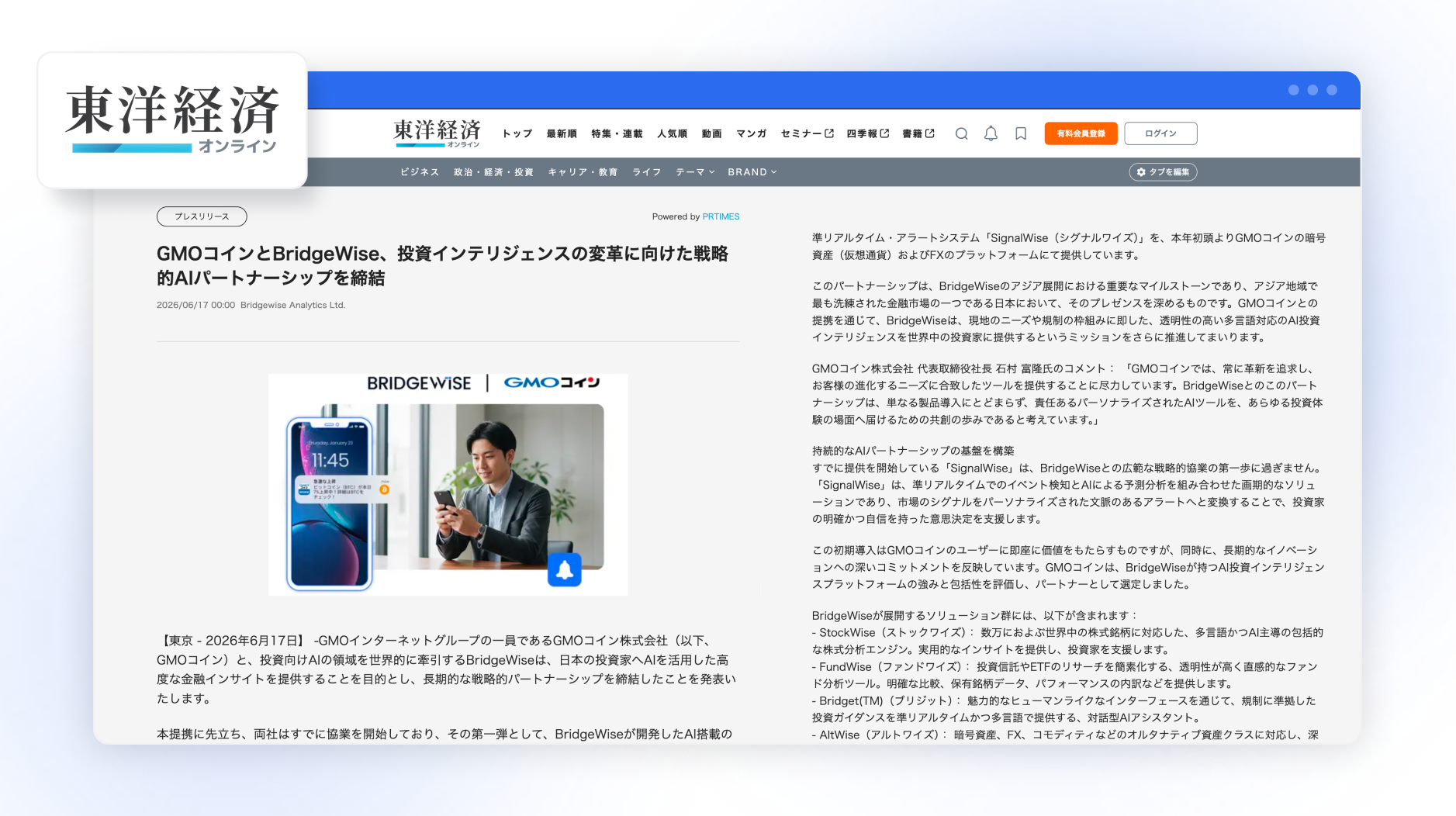
GMO Coin and BridgeWise have formed a strategic AI partnership to transform investment intelligence.
GMO Coin, Inc., a member of the GMO Internet Group, and BridgeWise, a global leader in AI for ...

Investors today expect more than just data, they expect an experience that feels intuitive, intelligent, and tailored to their goals. With AI now powering much of the financial decision-making journey, portfolio creation is evolving from a labor-intensive task into a guided, insight-driven process. This article explores how AI is transforming not just what investors can access, but how they navigate the entire process, bringing speed, clarity, and customization to portfolio construction.
We’ve defined “investor experience” as a cross between what you expect from a user-friendly app and a range of financial tools that help you to identify and evaluate outstanding investment opportunities. Much of this functionality uses artificial intelligence, which is great at:
Now, let’s take this a step further. Artificial intelligence is also excellent at detecting patterns. So, instead of you poring through a variety of AI-generated reports about stocks and funds, it can instead deliver a summary of top investment recommendations to consider and reduce your workload.
The always-on nature of AI-powered investment platforms means that opportunities can be identified as they occur, instead of you reading about them in the morning financial news. This allows you to invest before the rest of the market wakes up and prices adjust to the latest changes. In short, a quality investor experience enables you to build portfolios from a broader range of securities, with less analytical effort and in a fraction of the time.
Not interested in taking your hands off the wheel yet? Here are four reasons why a good investor experience keeps you in the loop so that you have confidence in your decisions.
While it’s true that a busy investor often wants a big-picture view, it is sometimes important to analyze the details. This might be the case, for example, if you are in search of an ethical investment or considering an industry-based fund and want to view individual holdings. Although robo-advisors fulfill this ability to an extent, AI breaks a lot of complex information down into language that even casual investors can understand. It also adds graphical and chart summaries to clarify trends and comparisons. The overall result is an investor who understands more about what is driving value and so has greater trust in the platform and their broker.
Hand in hand with the ability to clarify details comes a range of customization options. Some investors believe that a few select ratios are the best indicators of trends and values, and have no interest in whole summaries of balance sheet/income statement/cash flow. Others want to look at non-standard accounts like EBITDAC that need to be calculated by the investor. Financial AI makes it possible to collate ratios across potential investments instead of looking at individual filings or companies. Some platforms even allow you to create ratios so that you can go beyond the boilerplate of standard accounts. The goal here is to reveal opportunities that go unnoticed by other investors so that you can be among the first to jump onboard.
Once you have customized your information feed and favorite markets, the analytical tools of an investment platform enable you to easily gauge your success. By looking at what sorts of data have benefitted you most, you can hone your strategy to an optimal level. Then, if you want to watch how things progress for a bit, all you need to do is track your returns. In the meantime, AI can feed you data on emerging opportunities so that you can consider new alternatives.
A critical issue when it comes to investor confidence – as well as the fate of any brokerage firm – is that of compliance. It’s not something that individual investors think about much, unless something goes wrong. But, for brokers, it should be top of mind. From AI hallucination to malicious software, AI finance platforms face a multitude of risks, particularly if they are relying on technology (and not humans) to provide investment recommendations. Fortunately, as AI risk awareness and programming advances, more regulatory bodies are certifying advanced platforms to deliver AI-based advising to clients.
Taken together, these capabilities signal a meaningful shift in how investors engage with markets. AI isn’t replacing the investor’s judgment; it’s strengthening it, offering deeper insights, streamlined workflows, and guardrails that make decision-making more robust.
As platforms continue to earn regulatory trust and refine their models, brokers and investors who embrace these tools will gain a lasting competitive edge in an increasingly data-driven landscape. To learn more about the ways AI can enhance the investor experience on your platform, sign up for a demo today.
GMO Coin, Inc., a member of the GMO Internet Group, and BridgeWise, a global leader in AI for ...

Wealth AI in Europe: Where Compliance Meets the Neo Investor * { ...

Tokyo, Japan – June 17, 2026 — GMO Coin, one of Japan’s most respected and innovative financial ...