
Six ESG Highlights for 2026
With 2026 in full swing, many people are working to get their plans for the year moving forward. For ...
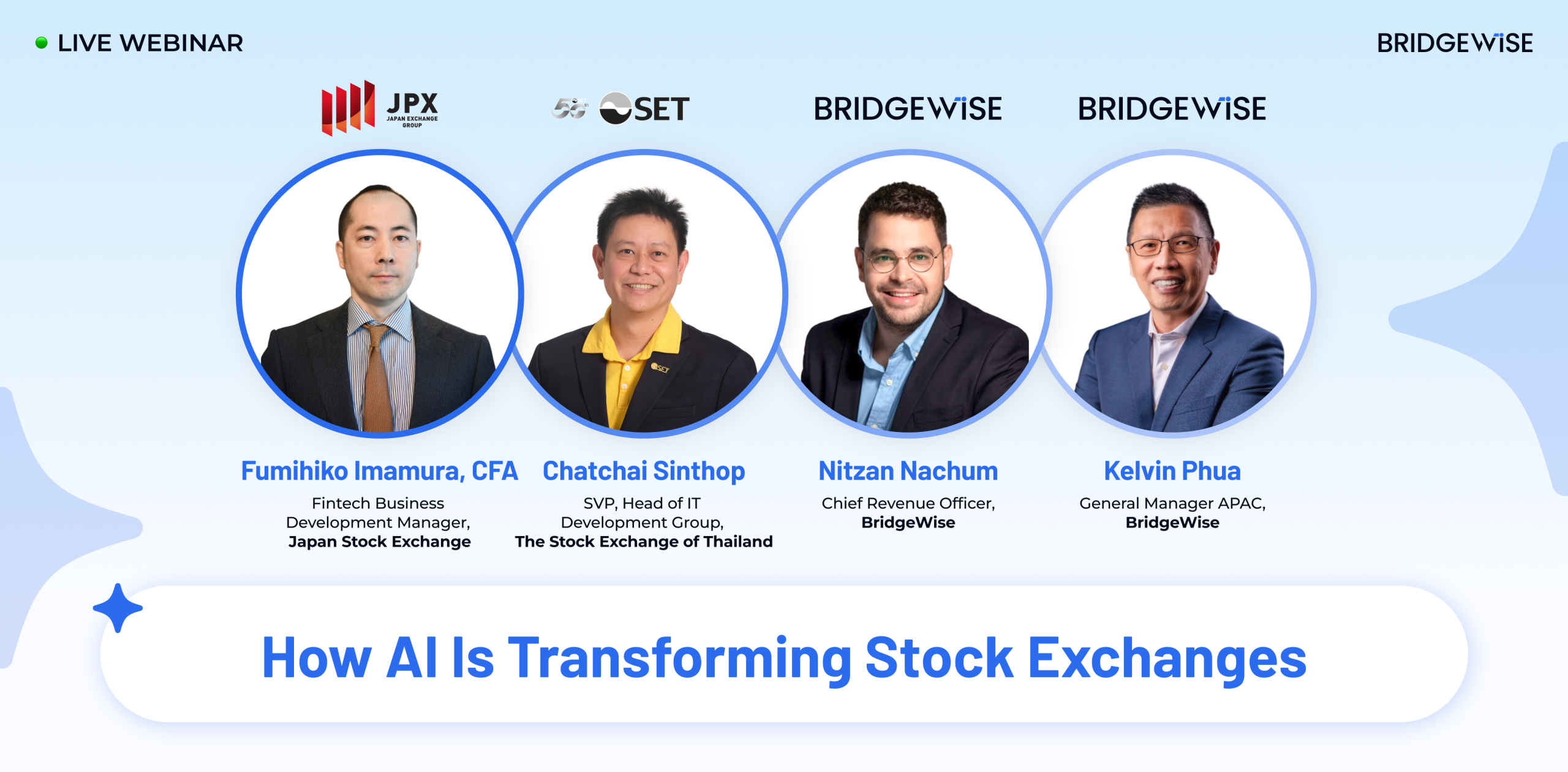
As part of our continuing series of webinars that bring together leaders from across the global investment industry, we wanted to explore the transformation that is happening right now to the world’s leading stock exchanges.
AI technologies are currently transforming nearly every facet of the way we work and create, and the impact on the world’s stock exchanges is no less profound.
In our recent webinar, “How AI is Transforming Stock Exchanges”, we were privileged to host two leading experts from the APAC region with deep experience at leading exchanges. They joined our in-house experts for an examination of the role AI is playing in ushering a new era for global exchanges.
Our expert panel featured:
Keep reading for key insights into the transformation taking place in global stock exchanges.
Fumihiko, from the Japan Stock Exchange, started the conversation by commenting on the way market trading has shifted from manual processes to data-intensive and ultra-fast environments. In that context, AI has the potential to serve as a critical filter, providing investors with a more manageable workload.
“Japan is facing a declining workforce, so we have to deal with more information with fewer human resources. To address this pain-point, AI can be a very effective solution. By adopting AI, we can screen and summarize information so people can deal with the flow of information going through the market.”
Chatchai, of The Stock Exchange of Thailand, noted a gradual adoption of AI technologies following a marked rise of high-frequency trading since 2013. In that light, generative AI and other solutions are making market insights more accessible to retail investors.
“In 2019, we began using AI for customer segmentation. We used it to segment investors so we could deliver the right insights and information feeds to investors. That was our approach before we entered the world of generative AI a couple of years ago.
“More recently, we’ve seen many changes. For example, just a few months ago Google Finance released a beta version that includes a lot of interesting new content; material that retail investors didn’t have access to before.”
Nitzan, from BridgeWise, began his comments by emphasizing the role AI can play in bridging knowledge gaps and tacking language barriers. Solving these challenges plays a key role in AI’s ability to help analysts and platforms dramatically scale the assets they cover.
“We address two major challenges my colleagues mentioned. First, while there is an enormous amount of data, there aren’t enough people to analyze it. Analysts do an amazing job, but AI enables them to increase their workload so they can cover many more assets.
“Second, AI can generate insights in any desired language. A great example is our partnership with JPX, the Japanese Exchange Group. Through our joint Market Explorer project, retail investors, whether they’re in Turkey, Brazil, or anywhere else, can access information in their own language about any asset they want to explore in the Japanese market.
“This is a significant revolution, one that only AI can deliver. And we see clearly that these types of solutions match the demand that’s out there in the market.”
Chathai went on to comment on the multiple ways AI has been adopted by the Thai Stock Exchange, and placed a special emphasis on its role in increasing accessibility to market information.
“First, we improved market accessibility. We host an event called Opportunity Day, which allows listed companies to present their performance through video. These videos are published publicly for investors. AI now transcribes the videos into text and generates summaries. So far, more than 700 videos have already been transcribed. This helps people process data more efficiently and gain deeper insights than they could from video alone. That’s the first way AI improves accessibility.
“The second improvement is in overcoming language barriers. Most Thai people prefer the Thai language, and we use AI translation in our annual reporting system. When listed companies submit their reports in Thai, AI automatically translates them into English. This greatly improves access for foreign investors who are more familiar with English. In the first month after launch, about 200 listed companies had their annual reports translated. That’s the second major benefit.”
Fumihiko provided insights into the ways AI can help financial institutions mitigate the risks of technological disruption, while also maintaining necessary standards.
“Exchanges are places where the highest standards of responsibility and accountability are required. We place this principle at the very basis of our AI usage. However, that doesn’t mean we avoid AI. In fact, not adopting AI is often riskier than adopting it. We use AI across a wide range of business areas.
“For exchange-specific activities, we also use AI for market monitoring. Previously, this was done manually, humans would review order books to detect unnatural or abnormal orders entering the market. If anything looked suspicious, we would call brokerage firms to verify. Now, we can react more quickly and with less effort by leveraging the latest technologies.”
AI adoption across stock exchanges and other financial institutions is progressing rapidly, and our experts agreed on the core role the technology will play moving forward. If you would like to know more about the role AI can play in transforming your institution, sign up for a demo of BridgeWise AI solutions today.
With 2026 in full swing, many people are working to get their plans for the year moving forward. For ...

Generative AI has moved quickly from experimentation to production, but in financial services, ...

BridgeWise , the global leader in AI for investments, has today announced an international ...